




A website redesign usually takes about as long as building a new website, which for most small and mid-sized business sites is a few weeks to a few months, plus time for the redirect map and SEO checks at launch. A visual refresh on the same platform sits at the short end, while a redesign that changes platforms, rewrites copy, or adds custom features like booking sits at the long end. How fast content and user feedback come back is usually the biggest variable.
If you are an owner planning a redesign, a realistic website redesign timeline helps you judge a quote and leave room for launch work. Below I cover timelines by project size, the phases of the work, what slows a project down, the difference between a refresh and a full redesign, and what Google actually says about SEO after you go live. The ranges come from published sources I checked on November 18, 2026. I want realistic expectations, not an invented average.
How long does a website redesign take by project size?
The closest public benchmark is GoodFirms’ 2026 website cost survey of more than 300 web development companies across 31 countries, run in April to May 2026 and updated October 14, 2026. Those figures are the typical timeline reported by firms for website projects, not a survey of redesigns only. A redesign of similar size usually lands in the same neighborhood as building a new website, plus the work of mapping old URLs and checking SEO at launch.
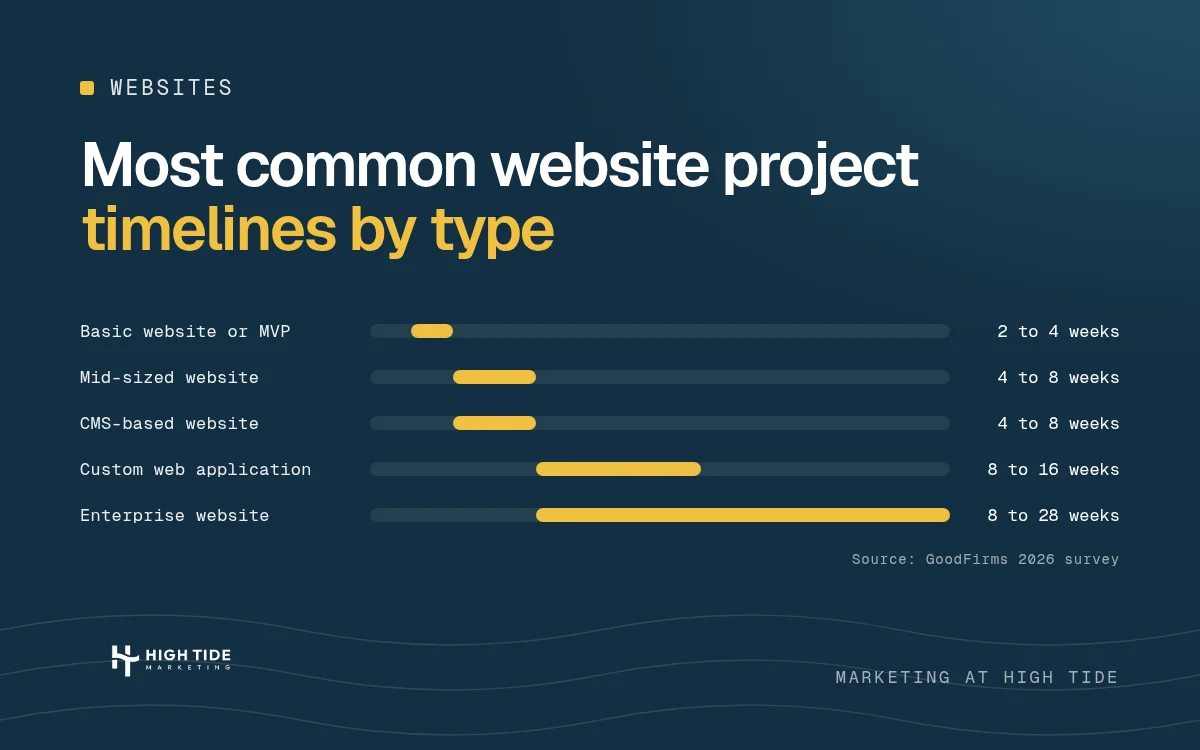
Here are the most common answers by project type:
| Project type | Most common timeline | Share of firms in that band |
|---|---|---|
| Basic website or MVP | 2 to 4 weeks | 71% |
| Mid-sized website | 4 to 8 weeks | 50% |
| CMS-based website | 4 to 8 weeks | 36% |
| Custom web application | 8 to 16 weeks | 36% |
| Enterprise website | 8 to 28 weeks | 32% |
For mid-sized sites, the split matters: half of the firms landed on 4 to 8 weeks, and another 32% said 8 to 16 weeks was more realistic. For custom web applications, 35.5% of firms (rounded to 36% in the table) chose 8 to 16 weeks, and nearly 68% landed between 8 and 28 weeks. Enterprise work and other complex projects spread further: 32% estimated 8 to 16 weeks, 31% said 16 to 28 weeks, and nearly 19% said 28 to 36 weeks or longer. The survey’s typical duration for an e-commerce site was 8 to 28 weeks.
Project size is not the same as company size. A small business can still have a large scope if the redesign changes platforms, rewrites a lot of copy, or adds interactive features. Page count helps, but a redesign based on a modest site can still run long if content volume is high, or if many pages need new copy. Budget and calendar usually move together, which is why website redesign cost is worth reading next to this timeline.
What are the phases of a website redesign, and how long does each take?
I have not found a survey that times each step of the website redesign process on its own, so I will not invent a week count for every stage. The overall redesign project still usually falls in the bands above. The work typically moves through a discovery phase, planning, site structure and information architecture, visual design, a development phase and content migration, a redirect map and SEO setup, stakeholder review, then launch and quality assurance. Those phases overlap, so adding every published range end to end overstates the calendar. A redesign also includes work a brand-new site does not: a URL inventory of the old website, redirects, and moving existing content. The website redesign checklist walks through those launch steps.
Discovery phase and project scope
The redesign process should start with project goals, an audit of the current site, and a clear project scope. At project start, before the redesign starts, agree on essential pages, key service pages, and whether you need custom design, custom development, custom functionality, CMS development, or CMS integration. When it is useful, discovery can include competitive analysis, user research, or UX research.
Content readiness belongs here too. Prepared content keeps a website redesign project moving. Content creation, creating content you do not already have, and later content production are often what stretch the calendar.
Development phase and quality assurance
After visual design, including responsive layouts, the development phase turns approved designs into working pages. This is also when content migration happens, and when reusable components can keep a large build consistent. Quality assurance should include thorough testing of forms, devices, and accessibility testing, plus a content review and design approvals before you set a launch date.
HubSpot’s guide to how long it takes to build a website, updated May 8, 2025, does publish phase ranges for a new build with a development firm:
| Phase | HubSpot’s published range |
|---|---|
| Initial communication and goal setting | 1 to 3 weeks |
| Creating an action plan | 1 to 2 weeks |
| Design mockups and feedback | 2 to 3 weeks |
| In-depth development | 1 to 2 months |
| Review and revision | 1 to 2 weeks |
HubSpot notes that development can stretch to three or even four months if you keep adding changes. It also says a professionally built site can take five to six months from start to finish, including one week to one month spent choosing a developer. That clock is different from GoodFirms’ project-duration figures, so I am keeping the two sources separate.
How long does a small website redesign take?
It depends on what “small” means. If you are refreshing a simple site on the same platform, and most of the content is already written, you can sit at the short end. GoodFirms found that 71% of firms said a basic website or MVP takes 2 to 4 weeks. A small business site should not automatically be budgeted as a two-week job if it needs new copy, new photography, a new sitemap, or a platform change. Ready content and fast feedback are what keep a small website redesign short.
What slows a website redesign down?
Website redesign delays usually come from ordinary reasons.
Content and feedback arrive slowly. This is the variable I mentioned up top, and the one you control the most. Each extra round of design or copy changes adds days or weeks. Slow content review and late design approvals have the same effect.
The scope grows after kickoff. Scope changes and scope additions cause timeline extensions. New pages, complex integrations, or a platform change stretch the development phase. That is the same issue HubSpot flags when development stretches.
Access and decisions show up late. Domain, hosting environment, analytics, and Search Console logins often take longer to find than anyone expects. If you are also changing hosts, fold that into the plan. Multiple stakeholders, with no single decision maker, slow the client side of the work.
The URL inventory is left until the end. Every important old URL needs a destination. If that map is built after launch, you are fixing SEO problems under time pressure. Before moving forward to launch, test the entire site, not just the homepage.
If you are still deciding whether you need a full redesign or a smaller refresh, these signs you need a new website can help you draw the line.
Is a website refresh faster than a full redesign?
Usually, yes. A refresh keeps the same platform and often the same URLs. You update the look, fix usability issues, and revise some content, without rebuilding the information architecture or migrating everything to a new system. You can skip most of the redirect map when page addresses do not change.
A full redesign is closer to a new build, plus migration. If you change domains or rewrite the URL structure, you are also doing a site move, which is the case Google’s SEO guidance below is written for. I do not have a sourced average for how many weeks a refresh takes. A same-platform visual refresh sits at the short end of the ranges above. A redesign that changes platforms, structure, or a lot of content sits at the long end.
How long does it take for SEO to settle after a redesign?
It depends on whether the URLs change, and Google does not publish a guaranteed recovery date either way.
If you keep the same URLs and mainly change design or content, Google is recrawling updated pages, not processing a site move. I have not seen an official timeline from Google for how long rankings take to settle in that situation, so I will not invent one.
If URLs change, follow Google’s documentation on site moves with URL changes (last updated August 20, 2026). Google says you should expect temporary ranking fluctuation while it recrawls and reindexes the site. As a general rule, for medium-sized websites it can take a few weeks or more for Google to gradually start showing the new URLs instead of the old ones, and larger sites take longer. The same document also says a small to medium-sized website can take a few weeks for most pages to move. Speed depends on the number of URLs and server speed. A sitemap can help discovery.
That “few weeks or more” is about showing new URLs in place of old ones, not a promise that traffic will be back on a set date. Google also says visibility may fluctuate temporarily, that this is normal, and that “a site’s rankings will settle down over time.” That last phrase is not a numbered deadline.
Permanent redirects such as 301s do not cause a loss in PageRank. Google recommends keeping redirects in place as long as possible, generally at least one year. When you can, change only one major thing at a time.
If the move is from one domain or subdomain to another, Google’s Change of Address tool can be used after redirects are in place. The tool’s actions continue for 180 days. After that window, Google says it does not recognize a relationship between the old and new sites if the old site is still present and crawlable. That is a tool window, not a date when SEO finishes. Maintain those redirects for at least 180 days, and longer if Search still sends traffic to the old URLs. The safer planning number from the site-move document is at least one year.
Google also warns that combining a site move with a redesign of content and URL structure will probably come with some traffic loss, because Google may need to relearn and reassess the individual pages. A careful redirect map, updated sitemaps, and post-launch checks in Search Console help protect what you already have. After that, website maintenance is what keeps the new site current.
How long does a custom website redesign take with an agency?
There is no separate “agency redesign” survey figure I can cite. A custom website redesign with an agency usually follows the same bands as a custom build of similar scope. For a mid-sized business site, that is GoodFirms’ mid-sized split: 50% at 4 to 8 weeks, and 32% at 8 to 16 weeks. If the work is closer to a custom web application, the most common band was 8 to 16 weeks, and nearly 68% of firms landed between 8 and 28 weeks.
The agency’s calendar is not the whole story. Content, feedback, and access still sit on your side, and a custom redesign still needs the redirect map, quality assurance, and launch support. When you compare proposals, ask what the website redesign project includes: discovery, design rounds, content, migration, redirects, how many revision rounds are assumed, and whether the launch date is a single cutover or a phased launch. If those are vague, the end date will be too.
Frequently asked questions
How long does a website redesign take?
A few weeks to a few months for most small and mid-sized business sites, plus redirects and SEO checks at launch. In GoodFirms’ 2026 survey, half of firms said a mid-sized website takes 4 to 8 weeks, and another 32% said 8 to 16 weeks.
How long does a small website redesign take?
A simple refresh can sit near the short end. GoodFirms found 71% of firms put a basic website or MVP at 2 to 4 weeks. Plan longer if you are rewriting copy or changing platforms.
How long does a custom website redesign take with an agency?
Use the same custom-build ranges. Mid-sized sites most commonly take 4 to 8 weeks or 8 to 16 weeks in the GoodFirms survey. More complex work often lands between 8 and 28 weeks.
Is a website refresh faster than a full redesign?
Usually, because a refresh keeps the platform and often the URLs. I do not have a sourced average for how many weeks a refresh takes.
How long does it take for SEO to settle after a redesign?
If URLs change, Google says that for medium-sized sites it can take a few weeks or more to start showing the new URLs, and that rankings settle down over time. That is not a guaranteed recovery date. Keep redirects in place, generally for at least one year.
Can a website redesign be finished in a week?
A very small visual refresh with ready content might be. A custom redesign with research, new copy, unique design, and SEO setup usually takes longer.
A straight next step
If you want help thinking through a realistic timeline for your site, see how we handle websites or book a discovery call. We will look at what you have now, whether a refresh or a full redesign fits, and what would need to happen before launch. Pricing only happens on that call, after the scope is clear. If we are not the right fit, I will tell you.
Sources
All figures in this article come from the sources below. I checked each page again on November 18, 2026. Dates are the publish or update dates on those pages when they were shown.
-
GoodFirms, “Website Development Cost 2026: How Much Does a Website Cost?”, updated October 14, 2026. Survey of 300+ web development companies, agencies, and independent professionals across 31 countries, conducted in April to May 2026. Most common timelines: basic website or MVP, 2 to 4 weeks (71%); mid-sized website, 4 to 8 weeks (50%), with another 32% saying 8 to 16 weeks; CMS-based website, 4 to 8 weeks (36%); custom web application, 8 to 16 weeks (35.5%, rounded to 36% in the article table), with nearly 68% landing between 8 and 28 weeks; enterprise, most common band 8 to 28 weeks (32.2%), with a split of 32% at 8 to 16 weeks, 31% at 16 to 28 weeks, and nearly 19% at 28 to 36 weeks or longer. The survey’s typical timeline table lists an ecommerce site at 8 to 28 weeks. These are typical website project timelines reported by firms, not a survey of redesigns only.
-
High Tide Marketing, “How Long Does It Take to Build a Website?”, November 1, 2026. Our build-time guide, which cites the same GoodFirms 2026 mid-sized figures (4 to 8 weeks for half of firms, 8 to 16 weeks for another 32%).
-
HubSpot, Doug Bonderud, “How Long Does it Take to Build a Website?”, updated May 8, 2025. An editor’s note says the post was originally published in September 2021 and has been updated. Published phase ranges for a new build with a development firm: initial communication and goal setting, 1 to 3 weeks; creating an action plan, 1 to 2 weeks; design mockups and feedback, 2 to 3 weeks; in-depth development, 1 to 2 months, which can stretch to three or even four months if the client keeps adding changes; review and revision, 1 to 2 weeks. HubSpot also says a professionally built site can take five to six months from start to finish, and that total includes time spent choosing a developer, listed at one week to one month. That is a different clock than GoodFirms’ project-duration figures.
-
Google Search Central, “Site Moves and Migrations” (site moves with URL changes), last updated August 20, 2026. Google says to expect temporary ranking fluctuation while it recrawls and reindexes a site. As a general rule, for medium-sized websites it can take a few weeks or more for Google to gradually start showing the new URLs instead of the old ones, and larger sites take longer. The same document also says a small to medium-sized website can take a few weeks for most pages to move, that speed depends on the number of URLs and server speed, that a sitemap can help discovery, that 301 and other permanent redirects do not cause a loss in PageRank, and that redirects should be kept in place as long as possible, generally at least one year. It also says visibility may fluctuate temporarily during the move, that this is normal, and that “a site’s rankings will settle down over time.”
-
Google Search Console Help, “Change of Address tool”. The tool is for moves from one domain or subdomain to another, after redirects are in place, not for every redesign and not for HTTP to HTTPS or same-domain path changes alone. Tool actions continue for 180 days. After that window, Google says it does not recognize a relationship between the old and new sites if the old site is still present and crawlable. The help page also says to maintain redirects for at least 180 days, and longer if Search still sends traffic to the old URLs. Google also warns that combining a site move with a redesign of content and URL structure will probably come with some traffic loss, because Google may need to relearn and reassess the individual pages.