



The difference between a website builder and a custom website comes down to who controls the design and where the site can live. A builder like Wix, Squarespace or GoDaddy gives you templates, hosting and an editor for one monthly fee, and your site runs only on that company’s platform. A custom website is designed and built for your business specifically, and you can usually host it, move it and change it however you want.
We build custom websites, so you should know where we stand. Builders are still the right choice for plenty of businesses, and the honest answer depends on what you need your website to do. Here’s a fair look at both, with real pricing and platform documentation so you can check our work.
What is an online website builder?
An online website builder is a hosted service that bundles everything you need to publish a site: templates, a drag-and-drop editor, hosting, security certificates and usually a domain offer. You sign up, pick a design, replace the text and photos, and publish. The big names are Wix, Squarespace and GoDaddy, and more of them now generate a first draft with AI.
Builders are popular for good reason. According to W3Techs, Wix runs about 4.2% of all websites and Squarespace about 2.4%, while WordPress runs about 39.5% as of late October 2026. Clutch’s 2025 small business survey found 41% of small businesses built their site on no-code tools like Wix or Squarespace.
The key technical point is that a builder is software as a service. Wix says it plainly in its help center: your site “needs to be hosted and operated on Wix’s servers” to work. Wix also states that the content you create belongs to you. You own the words and photos, but the site itself can’t run anywhere else.
What is a custom built website?
A custom website is designed for one business. The page list, layouts, navigation and calls to action come from research into your services, customers and competitors, not from a theme built for thousands of businesses at once.
“Custom” describes the design and structure, not a specific technology. A custom site can be hand-coded, built on a modern framework, or built as a custom theme inside a content management system like WordPress. What makes it custom is that someone planned and built it around your business. If you want to know what the site you’re looking at runs on, our guide on how to tell if a website is custom built walks through the checks.
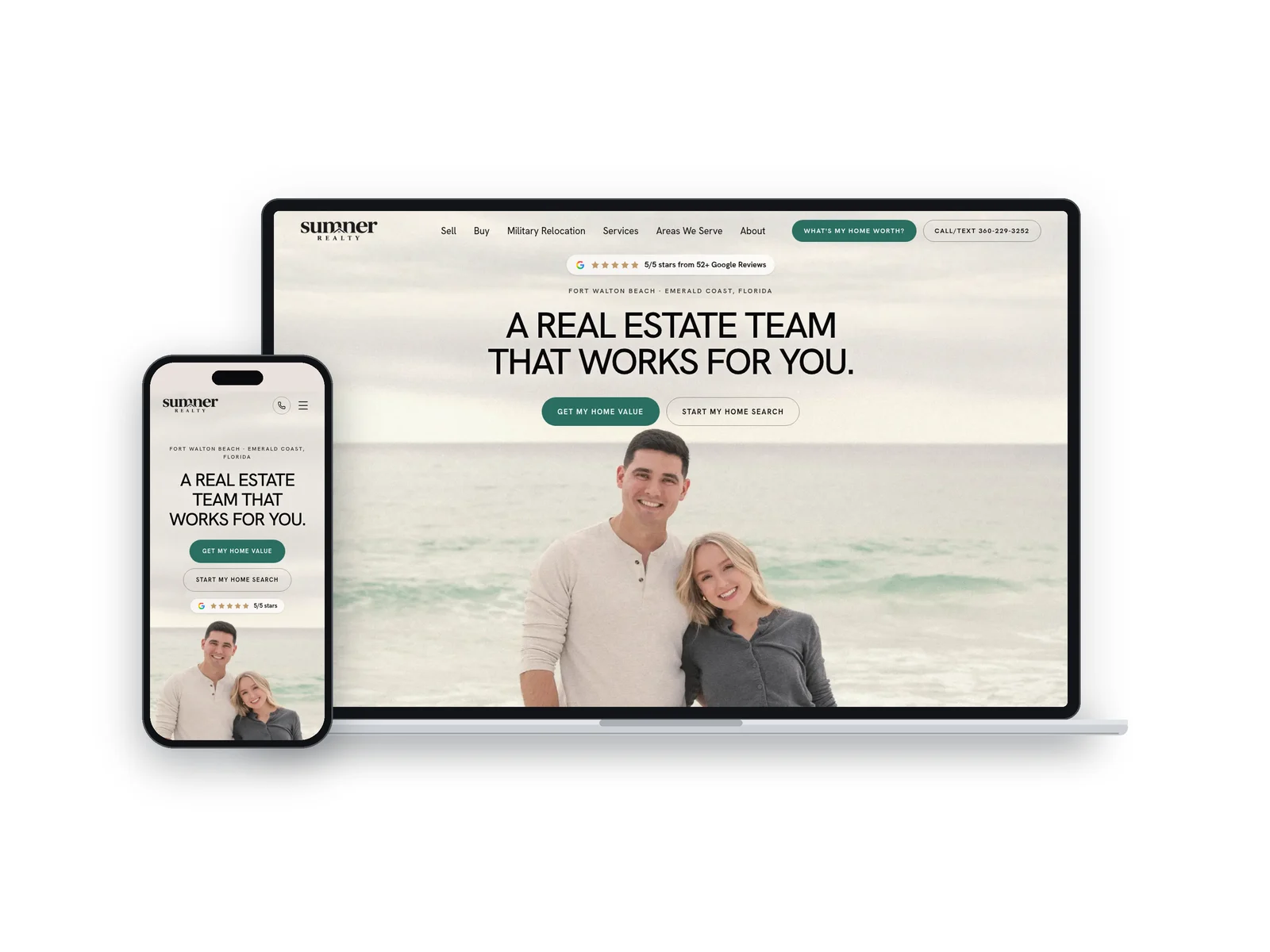
A custom website we designed and built for Sumner Homes, a home builder.
Website builder vs custom website compared
| Factor | Website builder (Wix, Squarespace, GoDaddy) | Custom website |
|---|---|---|
| Upfront cost | Low. A monthly plan, often with a free or trial tier | Higher. Pays for strategy, design, copy and development |
| Ongoing cost | Monthly or annual subscription for as long as the site is live | Hosting and maintenance, or a managed monthly plan |
| Speed to launch | Hours to a few weeks, mostly limited by your own time | Several weeks to a few months |
| Design control | Inside the limits of the editor and template | Anything you can plan, designed around your brand |
| Performance | Handled by the platform. Many builders now perform well | Can be built lean, but depends on the developer |
| SEO | Solid basics, limited control over structure and code | Page structure, schema and URLs planned around your searches |
| Ownership | You own your content. The site runs only on the platform | Depends on your contract. Should be in writing |
| Portability and lock-in | Moving away usually means rebuilding | Can move hosts if you own the code and accounts |
| Scaling | Fine until you need features or page types the platform lacks | Built to add services, locations and integrations |
The rows that cause the most confusion are cost, SEO and ownership, so let’s go through them.
Cost
Builders win on upfront price. At the time of writing, Wix’s paid plans range from $17.77 a month for Light to $159.77 a month for Business Elite when billed yearly, and Wix offers a free plan that runs on a Wix address. Squarespace’s plans run from $19 a month for Basic to $99 a month for Advanced on annual billing, or $25 to $139 billed monthly. Squarespace’s Basic plan also adds a 2% transaction fee on online store sales. GoDaddy’s Website Builder starts free with 50 AI credits a month, and its site lists current paid plan pricing.
Both Wix and Squarespace include a free domain for the first year on annual plans. Squarespace’s pricing page notes the domain then renews at its standard rate. We cover what that renewal looks like in how much a domain costs.
A custom build costs more upfront because someone is doing research, writing, design and development for your business specifically. Some agencies charge a one-time project fee. Others, including us, offer managed website plans that spread the cost into a monthly payment. For a full breakdown, see our guide to custom website cost.
The fair comparison also counts your time. A builder site that takes an owner 40 evenings to set up isn’t free, and neither are the leads a weak site never captures.
Speed to launch
A builder can be live the same day if your content is ready. A custom website takes longer because the planning happens before the design. For most small business sites, that means several weeks to a few months, depending on page count, how fast content and feedback come in, and integrations like booking or CRM sync.
Design control
Builders give you a lot of design freedom inside their editor. You can change fonts, colors, images and section layouts. The limits show up when you want something the editor wasn’t built for: a unique service page layout, a custom quote calculator, a specific way of showing locations, or a mobile layout that behaves differently from desktop.
With a custom site, the design starts from what your customers need to see to make a decision. There’s no template boundary to work around.
Performance
Builders have gotten much faster. The HTTP Archive’s 2024 Web Almanac measured the share of mobile sites passing all three Core Web Vitals by platform. Squarespace reached 60% and Wix 57%, against 51% across all sites and 40% for WordPress.
So a builder site can beat a poorly built custom site. The advantage of custom is control. A developer can ship only the code each page needs and fix a slow page directly, instead of waiting for the platform to change.
SEO
Google doesn’t rank a site higher or lower because of the platform name. Every major builder handles the basics: page titles, meta descriptions, mobile layouts and SSL. What builders limit is structure. You may struggle to create dozens of unique service and location pages, control heading order, add specific schema types, or keep URLs exactly how you want them.
A custom site starts from keyword and competitor research, so the page list itself is part of the SEO plan. Every site we build is SEO and AI SEO ready from day one. Our guide to SEO-friendly website design covers the decisions that matter most.
Ownership, portability and lock-in
This is the row most owners don’t think about until they want to leave.
On Wix, the site can’t be exported to another host because, as Wix explains, it “uses Wix’s proprietary technology”. On Squarespace, you can export certain content to a WordPress file, but Squarespace notes that not everything will export, since many features rely on its own code. GoDaddy’s newer AI builder says you can export your code, which is a welcome change, though you’d still need somewhere to host and maintain it.
With a custom site, ownership depends on your contract. Some agencies keep the site and code if you leave. Ask before you sign. Our managed website clients own their website after the first year, and we think that should be standard.
Either way, your domain is separate from your website. You can and should own it no matter which route you choose. Our guide to what a custom domain is explains why.
Scaling
Builders work well until you need something they don’t offer. Common breaking points we see are multi-location businesses that need a page for every city, companies that need custom forms tied into a CRM, and brands that want their website to look nothing like their competitors’. App marketplaces fill some gaps, but each app adds a monthly fee and more code to the page.
A custom site is planned to grow. Adding a new service page or location follows the same structure as the rest of the site.
Who should use a website builder?
A builder is often the right choice when:
- You’re just starting out and need a credible site this month
- Your website budget is a few hundred dollars a year
- You have one or two services and a simple message
- Most customers come from referrals and only check that you’re real
- You enjoy doing it yourself and have time to keep it updated
- You’re testing a new idea before investing heavily
If that’s you, pick a builder, choose one of its own templates, write clear copy in your customers’ words, and register your domain in an account you control.
Who should get a custom website?
A custom website tends to pay off when:
- Your website needs to bring in new customers from search, not only confirm referrals
- You offer several services or serve several areas, each needing its own page
- You compete against established businesses with strong websites
- You need integrations like booking, intake forms or CRM sync
- Your brand needs to look clearly different from competitors using the same templates
- You’ve hit the limits of your builder and keep paying for apps to work around them
If several of these fit, compare the cost of a custom build against the value of the leads your current site is missing.
Moving from a website builder to a custom website
Plenty of businesses start on a builder and move to custom once the business grows. That’s a reasonable path. The move is where rankings get lost, so plan it carefully.
- Confirm you control your domain. If the domain was registered through the builder, you can usually keep it connected to the new site or transfer it to another registrar. Under ICANN’s transfer rules, a domain can’t move to a new registrar within 60 days of its initial registration or a previous transfer, so check dates early.
- Inventory your current URLs. List every page, blog post and image that gets traffic, so nothing important disappears.
- Map old URLs to new ones. Set up 301 redirects from each old address to its closest new page. Google’s guide to site moves with URL changes explains the process.
- Export what you can. Copy text, download original images and export blog content if the platform allows it. Don’t cancel the builder plan until the new site is live and checked.
- Rebuild forms and tracking. Reconnect contact forms, analytics, ad pixels and email signups, then test every one.
- Watch Search Console after launch. Check for crawl errors and pages that dropped out of the index for the first few weeks.
Our website redesign checklist covers each step in more detail, including what to watch in the weeks after launch.
Frequently asked questions
Is Wix or Squarespace a custom website?
No. Wix and Squarespace are website builders. You can customize a template a lot, but the site is built inside their editor and runs only on their servers.
Is a custom website better for SEO than a website builder?
Not automatically. Builders handle SEO basics well. A custom site gives you more control over page structure, schema, URLs and speed, which matters most in competitive markets.
Can I move my Wix site to another host?
Not as is. Wix states that sites must run on its servers. You can keep your domain and copy your content, but the site itself has to be rebuilt elsewhere.
Do I own my website on a website builder?
You own the content you create, but the site depends on the platform and your subscription. If you stop paying, the site goes offline.
How much does a custom website cost compared to a builder?
Builders cost a monthly fee, often under $50 a month at the time of writing. Custom sites cost more upfront or as a managed monthly plan. See our custom website cost guide for real ranges.
Can I keep my domain if I switch from a builder?
Yes. Your domain is separate from your website. You can point it at a new site or transfer it to a registrar you choose, as long as you can log into the account that holds it.
Get a straight answer for your business
We build custom websites for service businesses, and every site is custom, never templated. You work directly with me and our tight-knit team with 20+ years of combined experience, and we help clients set up and connect their domain as part of the build, with the domain account in the business’s name. See how we approach custom websites for service businesses, or book a discovery call. In 30 minutes we’ll look at your current site and competitors and tell you honestly whether a builder or a custom site makes more sense.