



If your marketing feels busy and revenue still stalls, the problem is usually not a missing tactic. It is that effort is spread across every channel at once, and the actual bottleneck never gets fixed.
This article is for business owners and marketers who want a practical map of how marketing changes from $0 to $50 million and beyond. It is High Tide’s adaptation of Acquisition.com’s $100M Scaling Roadmap and Alex Hormozi’s $100M Leads. The Core Four channels come from $100M Leads. The revenue thresholds, hiring path, and funnel notes are our adaptation. I will say that clearly wherever it matters.
There are eight stages, four ways to get customers, a funnel that starts at the bottom and moves up, a hiring sequence tied to the next constraint, and eight rules that do not change as you grow. Let’s dive into it.
The marketing strategy: one constraint at a time
I use a simple rule: one constraint at a time. Find the thing that is holding business growth back, put your best work there, and only open the next channel when the current one is maxed out. That is the marketing strategy underneath this roadmap. The channels change at each of the specific stages below. The rule does not.
The eight stages at a glance
Each stage has a different constraint, a different place in the funnel, and a different mix of channels. The dollar figures are High Tide’s adaptation of the Acquisition.com roadmap, not a promise that every business crosses them at the same pace.
| Stage | Revenue | Focus | The constraint | First key hire |
|---|---|---|---|---|
| 1 | $0 to $100K | Find the message | Proof and offer | None full time |
| 2 | $100K to $500K | Build one repeatable channel | Predictable lead flow | Setter or SDR |
| 3 | $500K to $1M | Turn on paid | Founder capacity | First closer |
| 4 | $1M to $5M | Pour fuel on what works | Profitable volume | Marketing manager |
| 5 | $5M to $10M | Build the department | Management | VP Marketing |
| 6 | $10M to $20M | Brand and breadth | Reach and platform risk | CMO |
| 7 | $20M to $50M | Category leader | Market share | Function VPs |
| 8 | $50M+ | Institution | Defense and new growth curves | Board-level CMO |
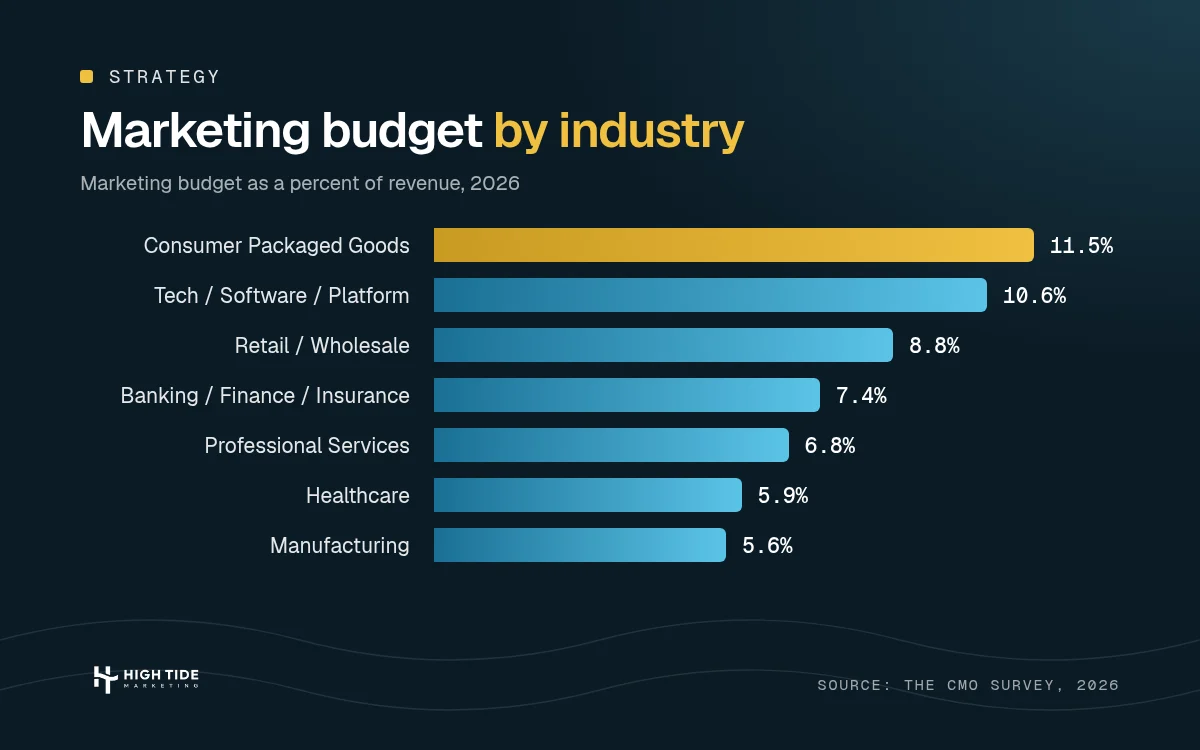
If you want a compact view of what a small business should spend at a given size, I already wrote how much a small business should spend on marketing and a sourced table of the average marketing budget by industry. This post is about what to do at each stage, not what the average company reports spending.
The Core Four: four ways to get customers
Hormozi’s Core Four, from $100M Leads, is a simple grid for lead generation. There are two kinds of people you can reach (people who already know you, and strangers) and two ways to reach them (one at a time, or many at once). Every tactic you already use fits in one of those four boxes.
Warm outreach (one to one, warm). Conversations with people who already know you: your network, past customers, referral asks, and reactivation. It costs time and almost no cash.
Organic content (one to many, warm). This is content marketing: free content for people who know you, or will, all at once, such as short form, YouTube, SEO, and a newsletter. It costs time now and compounds later.
Cold outreach (one to one, cold). Conversations with strangers, one at a time: cold calls, cold email, DMs, door knocking. It is labor heavy, and it scales with headcount.
Paid ads (one to many, cold). Paid attention from strangers, all at once: Meta, Google, YouTube, TV, and mail. It costs cash, and it scales with budget and creative.
There is a useful add-on that is not a fifth channel. “Lead getters” are other people running one of those four boxes for you: referrals, employees, agencies, and affiliates. They extend a channel you already chose. They are not a new one.
If a channel does not have a clear job, it is just activity. I wrote about that in more detail in how to give every marketing channel a job. In this roadmap, the job changes as you grow. Early on, warm and cold outreach do most of the work. Later, organic and paid take the lead, and outreach becomes support, targeted work, or a portfolio of lead getters.
How the funnel shifts
The work starts at the bottom of the funnel and moves up. That is High Tide’s read of where effort pays off at each stage. It is directional, not a measured study. In this map, retention includes referrals, upsells, and lifetime value (LTV).
- $0 to $100K: Decision. You are proving that someone will say yes, and learning the words that make them say it.
- $100K to $500K: Decision and retention. You need a repeatable close, and you start turning customers into a second source of leads.
- $500K to $1M: Interest and consideration. Paid traffic arrives, so you need a way to hold attention and help people decide without you on every call.
- $1M to $5M: Awareness and consideration. You are buying more reach, and the pages and offers have to convert it.
- $5M to $10M: Retention. Paid starts to saturate the warmest audiences, so LTV, community, and partners have to do more of the work.
- $10M to $20M: Awareness. The core niche is getting tapped, and you need reach in new markets without depending on one platform.
- $20M to $50M: Awareness and retention. You are defending share and deciding where the next dollar returns the most.
- $50M+: The full funnel. Budget goes to whichever part is the weak link.
Notice what this is not. It is not “run awareness ads from day one.” If the offer does not close in a live conversation, more strangers at the top of the funnel just help you lose money faster.
Stage 1: $0 to $100K, find the message
The constraint is proof and the offer. You do not yet know exactly who buys, why they buy, and what words make them say yes. Campaigns will not answer that. Conversations will.
Warm outreach is the primary channel. Talk to people who already know you: phone contacts, past coworkers and customers, local groups. When that list runs dry, cold outreach is the secondary channel. Pick one niche and do the volume. The deck uses Hormozi’s Rule of 100 here: 100 outreach actions a day. Organic content can start, on one platform, as a way to document the work and build a proof library. Paid ads stay off until the offer closes from live conversations.
The usual challenges are a vague offer that tries to serve everyone, no testimonials yet, outreach that stops the moment delivery gets busy, and jumping to a new channel every two weeks.
Keep the work tight. One offer, one ideal customer (one avatar), one problem, with a guarantee you can stand behind. Get a testimonial from every early customer. Track a simple chain: reached, booked, showed, closed. You do not need a full-time marketing hire. A part-time VA can help with admin. Learn the channels yourself. This is not the stage for an agency.
You are ready for the next stage when you have 10 or more paying customers and a 20% or better close rate on qualified calls. Those exit signals, like the other thresholds in this article, come from High Tide’s adaptation of the framework.
Stage 2: $100K to $500K, build one repeatable channel
The constraint is predictable lead flow. Revenue swings because leads still depend on how much time the founder has. The job is to turn founder outreach into a channel someone else can run, and to put a real referral program next to it.
Warm and cold outreach are both primary. Formalize referrals, including word of mouth referrals, with a real incentive and a set ask, not a vague “send me people.” Script and track cold outreach so a setter or SDR can run it. Organic content is secondary: one platform, one post a day, built from customer results, with a clear call to action. Paid can be tested, carefully, at $1,000 to $3,000 a month on retargeting and lead ads. That range is a test budget from the framework, not a High Tide package or fee.
This is also the stage where the numbers have to get real. Use one CRM and one pipeline everyone actually uses. Write scripts for outreach, setting, and closing. Aim for an LTV to customer acquisition cost (CAC) ratio of 3:1 or better, which is the target in the framework. If you are discounting to close, that is an offer problem, not a closing problem.
Hire a setter or SDR first, and a part-time editor or VA if content is starting to matter. Freelancers are fine. A full agency is still early. Watch leads by source, show rate, CAC, and LTV.
You are ready to move on when one channel drives most new revenue, and the founder is no longer the person booking the calls.
Stage 3: $500K to $1M, turn on paid
The constraint is founder capacity. The founder is still closing, posting, and approving everything, and outreach alone cannot make enough volume. The point of paid here is to buy back that time, not to “go big on ads.”
Paid becomes the primary channel, on one platform, where your buyer already is. Make it profitable before you add a second platform. Warm outreach is something you maintain: referrals, plus a reactivation campaign to every old lead. Cold outreach is secondary and should now be run by the setter team, not the founder. Organic is also secondary. The founder can still film. An editor should do the rest. Start building the email list on purpose.
The first ad dollars often lose money while you learn. A winning ad can fade in 3 to 6 weeks, which is why the framework calls for new creative every week and honest hook tests. Sales may not keep up with lead volume. People will argue about which channel “drove” the sale. None of that is a reason to turn paid off. It is a reason to measure it.
The key money rule at this stage is tighter than the standing rule I will cover later. The framework’s standing rule is that the first 30 days of gross profit should cover CAC. At Stage 3, the target is 30-day gross profit of at least 2 times CAC, with ads paying back in 30 to 90 days. Add a lead magnet and an email and SMS nurture so every click has a path. Run one weekly scoreboard that ties spend to cash, not to vanity metrics.
Hire the first closer, a video editor, and a marketing coordinator. If you use a paid media specialist, judge them on CAC, not on spend. The exit signal is practical: ads pay back in 30 to 90 days, and leads rise when the budget rises.
Stage 4: $1M to $5M, pour fuel on what works
The constraint is profitable volume. The first paid channel starts to hit diminishing returns, and creative, not targeting, is usually the bottleneck. A common pattern in the framework is that $10,000 a month works and $50,000 a month breaks CAC, unless the ads, the pages, and the offer keep up.
Paid and organic are both primary. Scale the winning paid platform, then add a second. Treat founder content as a trust engine: long form, then repurposed. Warm and cold outreach move to support. The email list, referrals, and upsells should become a real revenue line. A managed SDR team still helps for higher-ticket work, and can be a supplement for local businesses.
Do not buy more traffic until the pages are doing their job. Run 10 to 20 new ads a month, with test rules, and put conversion work on the pages first. Give sales and marketing one dashboard as the source of truth, so they stop blaming each other. An ascension offer (a next step that existing customers can buy) is how you lift LTV without finding a new audience.
This is the first stage that looks like a marketing team. Hire a marketing manager, a media buyer, a content producer, and an SDR lead. Agencies can help with creative or UGC and with SEO. A fractional CMO can help if you need senior direction before a full-time marketing leader is the right seat.
Watch blended CAC, marketing efficiency ratio (MER), and payback. The framework also flags marketing spend at 8% to 15% of revenue as a range to watch at this stage. That is a High Tide adaptation, not a rule for every business, and it is not a High Tide price. Compare it with the sourced industry figures in average marketing budget by industry, then set the actual number the way I described in how much a small business should spend on marketing.
You are ready for the next stage when two channels each drive 25% or more of new revenue, and ads can ship without the founder.
Stage 5: $5M to $10M, build the department
The constraint is management. You now have several channels, and each one needs an owner. Paid is starting to saturate the warmest audiences. The founder cannot be the operator of every number.
Organic and paid stay primary. Organic becomes multi-platform media: YouTube, a newsletter, and SEO that compounds. Paid becomes full-funnel work across three or more platforms, with YouTube and connected TV (CTV) for reach. Warm outreach is support, through customer marketing and community. Cold outreach is support too, usually as account-based work for the highest-value targets.
Give every channel one owner and a target CAC. Enforce brand guidelines, because the brand will otherwise look different in every channel. Build a partner and affiliate program so other people can become lead getters. When attribution gets messy, which it will with many touchpoints, trust holdout and geo tests more than a platform’s own reports.
Hire a VP of Marketing, channel managers, marketing operations, and someone who owns partnerships. A performance agency, a PR firm, or an SEO partner can sit around that team. Watch loaded CAC (acquisition cost with the real overhead included), cohort LTV, owned-audience share, and branded search.
The exit signal is about leadership, not a new tactic. Managers own their numbers. The founder is the face and the strategy, not the person running the daily work.
Stage 6: $10M to $20M, brand and breadth
The constraint is reach and platform risk. The core niche is getting tapped, and one algorithm change can cut lead flow overnight. You need awareness in new markets, and you need to stop depending on one or two channels.
Organic and paid stay primary, but the work looks different. Organic should run like an in-house media company, on a production calendar. Paid starts buying awareness at scale: CTV, radio, TV, mail, and sponsorships, not only performance ads. Warm outreach shifts to lead getters: affiliates, partners, events, and co-marketing. Cold outreach is targeted, used where deal size justifies enterprise or account-based work.
The usual challenges are slow decisions, silos, no awareness in the new market, and CAC that creeps up as you talk to colder audiences. The hire that matches this constraint is a CMO who owns the growth plan and the budget, not a senior person who only reports on channels. Around that seat, hire a brand lead, a creative director, and an analytics lead. A traditional media buyer, a PR partner, and a brand agency can support the work.
Run brand campaigns you can actually measure, with geo lift or media mix modeling (MMM), instead of hoping a last-click report tells the truth. Use flagship events to make both leads and content. Expand into an adjacent market only when you can measure CAC there, not because the current one feels boring.
The exit signal is about concentration risk: no single platform drives more than 40% of new revenue.
Stage 7: $20M to $50M, category leader
The constraint is market share. You now have multiple segments and regions. The question is no longer “what should we try?” It is “where does the next dollar return the most?” Spend like an investor.
Organic and paid remain primary. Organic becomes a media arm with its own team, and the founder is one voice inside it, not the whole thing. Paid is mass scale: TV, CTV, and out of home, alongside performance. Warm outreach is lead getters at scale: partners, affiliates, distribution, and loyalty. Cold outreach is account-based marketing for strategic accounts. If you sell in both business and consumer markets, the mix will not look the same, which is why I compared those models in B2B vs B2C marketing.
Bureaucracy will try to slow creative and testing. Teams will compete for budget. The board will want proof of brand ROI. The founder’s voice will be at risk of getting sanded down. The answer in the framework is to organize teams by segment, each with a growth target, to build an in-house creative studio, and to use media mix modeling to move budget. Buy audiences you own instead of only renting them from platforms.
Hire function-level VPs, a creative studio lead, and marketing finance. A media agency of record and a research firm can support that structure. Watch market share, aided awareness, and payback by segment.
You are doing this stage well when budget moves quarterly on marginal return, and you have top recall in the category.
Stage 8: $50M+, institution
The constraint is defense and the next growth curve. The core is mature, competitors copy you, and the real risk is getting slow and safe. There is no exit signal that means “you are done.” Budget goes to whichever part of the funnel is the weak link.
All four Core Four channels run as a portfolio. Warm work looks like distribution partnerships, channel partners, and licensing. Cold work is strategic accounts and enterprise deals. Organic is no longer a department that “posts.” It becomes the brand: owned media, community, and culture. Paid is mass media and always-on brand building.
Protecting the core can block new bets if you let it. New categories can dilute the main brand. Top marketing talent gets harder to keep. The framework’s answer is a brand architecture that can hold more than one brand, a separate team for new bets, and a willingness to expand by acquisition when that is the faster path. Owned audiences become a strategic asset, not a side list.
Hire a board-level CMO, a Chief Growth Officer, and regional heads. Global media and creative partners sit around that group. Watch category share, brand equity, and ROI by business unit.
Who to hire, and when
Hire for the next constraint, not for today’s leftover tasks. The list below is High Tide’s adaptation. It is a sequence, not a headcount target, and it is not a hiring package we sell.
| Stage | Revenue | In-house seats that typically appear | Partners, if you use them |
|---|---|---|---|
| 1 | $0 to $100K | None full time; a part-time VA | None. Learn the channels yourself. |
| 2 | $100K to $500K | Setter or SDR; part-time editor or VA | Freelancers only |
| 3 | $500K to $1M | First closer; video editor; marketing coordinator | Paid media specialist, judged on CAC |
| 4 | $1M to $5M | Marketing manager; media buyer; content producer; SDR lead | Creative or UGC, SEO agency, fractional CMO |
| 5 | $5M to $10M | VP Marketing; channel managers; marketing ops; partnerships | Performance agency, PR, SEO |
| 6 | $10M to $20M | CMO; brand lead; creative director; analytics lead | Traditional media buyer, PR, brand agency |
| 7 | $20M to $50M | Function VPs; creative studio lead; marketing finance | Media agency of record, research firm |
| 8 | $50M+ | Board-level CMO; Chief Growth Officer; regional heads | Global media and creative partners |
Two things are easy to get backward. First, do not hire a CMO at $200K in revenue because the title sounds serious. The constraint at that stage is still a repeatable channel, and a setter will do more for you. Second, do not wait until $10 million to think about senior marketing leadership. At Stage 4, a fractional CMO can cover the gap until a full-time VP or CMO is the right seat. I explained that role in what a fractional CMO is.
The rules that never change
The channels change. The rules do not. These eight come from the same adaptation of the Acquisition.com roadmap and $100M Leads.
- Fix the offer before you buy traffic. More leads into a weak offer lose money faster. If people will not buy after a real conversation, ads will not save it.
- Volume beats cleverness early. Most stalls are a volume problem, not a tactic problem. That is why Stage 1 is about 100 outreach actions a day, not a new tool.
- More, then better, then new. Add volume to the channel you have, then improve it, and only then add a new channel. Open the next one after the current one maxes out.
- Know LTV and CAC from Stage 2. Every scaling decision after that rests on the ratio and on payback. If you do not know those two numbers, you are guessing.
- Let customers fund acquisition. As a standing rule, the first 30 days of gross profit should cover CAC, so acquisition does not starve cash flow. At Stage 3, the target tightens to at least 2 times CAC in those first 30 days.
- Start founder content early. If you wait until $5 million to begin, you are starting years late on trust you could already have been building.
- Hire for the next constraint. Do not hire for the tasks you already know how to do. Hire for the bottleneck that is about to show up.
- Own the audience. Email, SMS, and community outlast rented reach. Platforms change the rules. A list you own does not.
If you want a practical list of the work that usually sits inside an early plan, use the small business marketing checklist. The checklist is the work. This roadmap is the order.
Frequently asked questions
What is the Core Four in marketing?
The Core Four is Alex Hormozi’s framework from $100M Leads. It says there are only four ways to get customers: warm outreach, organic content, cold outreach, and paid ads. Those four come from combining two audiences (people who know you, and strangers) with two methods (one to one, and one to many). Employees, agencies, affiliates, and referrals can run those channels for you. They are not a fifth channel.
How do I know which marketing stage I am in?
Use the constraint, not the revenue number alone. The dollar ranges are High Tide’s adaptation of Acquisition.com’s Scaling Roadmap, and they are a guide. If leads still depend on the founder’s calendar, you are in Stage 2 work, even if revenue has temporarily moved past $500K. If paid works and the team cannot keep up, you are in a Stage 3 or Stage 5 problem, depending on whether the bottleneck is a closer or a manager.
When should I turn on paid ads?
When the offer already closes from live conversations, and you can measure payback. In this roadmap, paid is on hold in Stage 1, tested in Stage 2, and primary in Stage 3, once ads can pay back in 30 to 90 days and leads rise when budget rises. If the offer is still weak, paid will only help you lose money faster.
When should I hire a CMO or a fractional CMO?
Not at the beginning. The first full-time marketing seat in this sequence is usually a marketing manager at Stage 4 ($1M to $5M), and a CMO shows up around Stage 6 ($10M to $20M), when reach and platform risk are the constraint. Between those points, a fractional CMO can give you senior direction without filling a full-time seat too early.
How much should I spend on marketing at each stage?
This article is not a spending formula, and it does not include High Tide prices. The framework flags a test budget of $1,000 to $3,000 a month when you first try paid in Stage 2, and a spend range of 8% to 15% of revenue as something to watch in Stage 4. For sourced industry benchmarks and a way to set the actual number, use average marketing budget by industry and how much a small business should spend on marketing. The better question, once you have a number, is whether 30-day gross profit covers CAC.
Do the same marketing rules apply from $0 to $50 million?
Yes. The channels and the hires change. The rules do not. Fix the offer before you buy traffic, get the volume up before you chase a clever tactic, add a new channel only after the current one is maxed out, know LTV and CAC, let customers fund acquisition, start founder content early, hire for the next constraint, and own your audience.
A straight next step
Find your stage. Name the one constraint that is actually in the way. Then put your time and money on the one or two channels that break it. That is how you scale marketing without doing a little of everything and finishing none of it.
If you want a second set of eyes on that, book a discovery call. We will look at where you are, what is holding growth back, and what is worth doing next. Pricing only happens on that call, after the work is clear. If we are not the right fit, I will tell you.
Sources
The stage thresholds, channel mix, hiring sequence, funnel focus, exit signals, and standing rules in this article come from High Tide Marketing’s November 2026 slide deck, “How to market your way to $50M+.” The deck’s source line, on multiple slides, reads: “Adapted from Acquisition.com’s $100M Scaling Roadmap and Hormozi’s $100M Leads. Thresholds and hires are High Tide’s adaptation.” The funnel slide adds: “High Tide Marketing’s read of where effort pays off at each stage. Directional, not measured.” The PDF’s creation date is November 4, 2026. I compared the PDF and the text export on November 13, 2026; they matched.
I am adapting and explaining that material in my own words. I am not reproducing the deck or the books at length. Official pages I fetched on November 13, 2026:
- Acquisition.com, “$100M Scaling Roadmap” diagnostic. Fetched November 13, 2026. https://www.acquisition.com/roadmap2
- Acquisition.com, “Alex Hormozi Books: The $100M Series,” including $100M Leads (“How to Get Strangers to Want to Buy Your Stuff”). Fetched November 13, 2026. This is the official book page I used for the Core Four attribution. https://www.acquisition.com/books
- Acquisition.com shop, “$100M Leads: How To Get Strangers To Want To Buy Your Stuff (Hardcover).” Fetched November 13, 2026. Official purchase page for the book. https://shop.acquisition.com/products/single-hardback
- High Tide Marketing, “How to market your way to $50M+” (Scaling roadmap, $0 to $50M+), 17-page deck. PDF created November 4, 2026. Internal source file used for this draft.
No third-party statistics were added beyond the figures already in the deck, which are attributed above as part of High Tide’s adaptation of the framework.