

To market a B2B business, decide exactly which companies and people you sell to, give them a clear reason to talk to you, show up on the channels they already use, and follow up on every lead fast enough to start a real conversation. For most small and mid-sized B2B companies, that means a website built to convert, search and LinkedIn for reach, email for nurturing and a sales process that works closely with marketing. Plan on spending roughly 7% to 12% of revenue on marketing, depending on how fast you want to grow, and judge the results by pipeline and revenue instead of clicks.
I’m Chantz Yager, founder of High Tide Marketing. When a B2B company comes to us, the same problems tend to show up: no clear ideal customer, a website that doesn’t ask for anything and leads that sit for days. This guide fixes each one, in the order we’d tackle them.
What is B2B marketing?
B2B (business-to-business) marketing is how a company that sells to other businesses attracts, convinces and keeps those business customers. Think of an IT services firm selling to medical practices, a manufacturer selling parts to distributors, a staffing agency selling to construction companies or a software company selling to finance teams.
Compared with consumer marketing, more people decide, the stakes are higher and the sales cycle is longer. If you want the full side-by-side, read our guide to the difference between B2B and B2C marketing. Here, we’ll focus on what to actually do.
How B2B buying works today
Before you pick channels, it helps to understand how your buyers make decisions. Three findings from large research firms should shape your whole plan.
Buying decisions are made by committees
Forrester’s State of Business Buying, 2024 found that, on average, 13 people within an organization are involved in a buying decision, and 89% of purchases involve two or more departments. The same research found that 86% of B2B purchases stall at some point during the process.
For a smaller deal, your “committee” might be an owner, an office manager and a bookkeeper. Either way, your marketing has to answer different questions for different people.
Buyers do most of their research before they call you
In a survey of 2,509 recent B2B buyers, 6sense found that 69% of the purchase process happens before buyers engage with sellers, and 81% of buyers choose a preferred vendor before they speak with sales. Gartner’s research on the B2B buying journey found that 75% of B2B buyers prefer a rep-free sales experience, although self-service purchases are more likely to end in regret.
Your website, content and reputation do most of the selling before anyone fills out a form. If you aren’t visible during that quiet research phase, you often never get a shot.
Most of your market isn’t buying right now
The LinkedIn B2B Institute’s 95-5 rule says that about 95% of your potential buyers aren’t ready to buy today. Their joint research with the Ehrenberg-Bass Institute found, for example, that 75% of companies buy computers once every four years and 80% change banking services once every five years.
If you only market to the 5% who are ready this month, you compete with everyone for the same small group. The companies that grow make sure the other 95% remember them when their time comes.
Step 1: Define your ideal customer profile and buying committee
Your ideal customer profile (ICP) describes the type of company that gets the most value from what you sell and is most valuable to you in return. Start with what your best five to ten clients have in common.
| ICP element | Questions to answer | Example |
|---|---|---|
| Industry | Which industries buy most and stay longest? | Multi-location dental and medical groups |
| Company size | Revenue, employee count or number of locations | 3 to 20 locations, 50 to 400 employees |
| Geography | Where can you serve well? | Southeast U.S. |
| Trigger events | What happens right before they need you? | Opening a new location, a failed audit, a new hire in leadership |
| Pains | What problem costs them money or sleep? | Systems that don’t talk to each other, slow onboarding |
| Disqualifiers | Who looks like a fit but never works out? | Single-location practices with no IT budget |
Then map the buying committee for a typical deal. You’re looking for the roles involved, what each one cares about and what proof they need.
| Role | What they care about | What to give them |
|---|---|---|
| Economic buyer (owner, CEO, VP) | Revenue, risk, return on investment | Business case, case studies, clear pricing guidance |
| Champion (the person who found you) | Looking smart, solving their daily problem | Content they can forward, a simple internal pitch |
| End users | Will this make my job easier or harder? | Demos, videos, onboarding details |
| Technical evaluator (IT, operations) | Fit, security, integration | Specs, documentation, references |
| Finance and procurement | Cost, terms, vendor risk | Pricing structure, contracts, insurance and compliance details |
As we cover in why marketing should start with the buyer, interview a few recent customers. Ask what was happening when they started looking, who else was involved and what nearly stopped them. Their words become your headlines.
Step 2: Plan for long sales cycles and the buyer journey
B2B buying doesn’t move in a straight line. Gartner describes six “buying jobs” that buyers loop through, often more than once: problem identification, solution exploration, requirements building, supplier selection, validation and consensus creation.
That gives you a practical way to plan content. For each job, ask what the buyer needs to see to move forward.
| Buying job | What the buyer is thinking | Content that helps |
|---|---|---|
| Problem identification | ”We need to do something.” | Short videos and posts about the problem, cost-of-inaction articles |
| Solution exploration | ”What options are out there?” | Guides comparing approaches, SEO articles that answer common questions |
| Requirements building | ”What do we need it to do?” | Checklists, buyer’s guides, requirement templates |
| Supplier selection | ”Who can do this?” | Service and industry pages, case studies, pricing guidance |
| Validation | ”Are we sure?” | Reviews, references, testimonials, FAQs, comparison pages |
| Consensus creation | ”How do we get everyone on board?” | One-page business cases, ROI calculators, recorded demos |
If deals take four months to close, a January campaign may not show revenue until May. Track leading indicators (qualified conversations, proposals, pipeline value) so you don’t kill a working channel too early.
Step 3: Sharpen your positioning and offers
Positioning is the answer to “why you, for us, right now?” Most B2B websites we review describe what a company does, but not who it’s for or why it’s the better choice. Try filling in this sentence:
We help [specific type of company] who [specific problem] get [specific outcome], unlike [the usual alternative], because [your real difference].
If the last blank says “great service” or “we care,” keep digging. Real differences are things like a narrow specialty, a faster process, a guarantee, local presence, a proprietary method or deep experience in one industry.
Next, build an offer ladder so every buyer has a next step that fits how ready they are:
- High-intent offers. A consultation, demo, quote, site visit or assessment. These are for the 5% who are ready.
- Mid-intent offers. A diagnostic tool, calculator, buyer’s guide, webinar or sample report. These help people who are researching.
- Low-intent offers. A newsletter, video series or LinkedIn follow. These keep you in front of the 95% who aren’t buying yet.
The high-intent offer matters most. “Contact us” is not an offer. “Get a free 30-minute operations review and a written plan” is.
Step 4: How much should a B2B company spend on marketing?
The two best-known surveys put total marketing spend for large companies at about 8% to 9% of revenue:
| Source | Marketing budget as % of revenue | Who they surveyed |
|---|---|---|
| Gartner CMO Spend Survey, 2026 | 7.8% | 401 marketing leaders, mostly at companies with $1B+ revenue |
| The CMO Survey (Duke, Deloitte, AMA), 2026 | 9.0% overall, 10.1% for B2B services companies | 308 U.S. marketing leaders, VP level or higher |
Smaller companies often need a higher percentage, because they’re building awareness from a smaller base and fixed costs like the website and CRM take up more of the budget. At High Tide, we use these bands as a starting point:
- About 5% of revenue to maintain your position
- About 7% for slow, steady growth
- About 10% for fast growth
- 12% or more for aggressive growth, a new market or a new service line
Our full breakdown of how much a small business should spend on marketing explains how to pick your band and work backward from cost per lead. If you’d rather plug in your own numbers, our free marketing budget planner builds a 12-month budget for you.
Split the budget between brand and demand
In The 5 Principles of Growth in B2B Marketing, Les Binet and Peter Field’s analysis for the LinkedIn B2B Institute found that B2B marketing works best with roughly a 50/50 balance between long-term brand building and short-term sales activation. Their data put the optimum near 46% brand and 54% activation, and they’re clear that it’s a guiding principle, not a precise rule.
For a small company, “brand” means helpful videos, LinkedIn content and sponsorships. “Activation” means search ads, retargeting and demo offers.
An example B2B marketing budget
Here’s an illustrative split for a B2B services firm with $3 million in revenue, spending 8% ($240,000 a year, or $20,000 a month). Your mix will differ.
| Category | Monthly | What it covers |
|---|---|---|
| Website, tracking and CRM | $3,000 | Hosting, updates, analytics, call tracking, CRM software |
| SEO and content | $5,000 | Service and industry pages, articles, technical SEO |
| LinkedIn (organic and ads) | $4,000 | Founder and company content, sponsored content, retargeting |
| Google Ads | $4,000 | High-intent search campaigns and retargeting |
| Video | $2,000 | Explainers, case study videos, short clips for social |
| Events and partnerships | $2,000 | Trade shows, sponsorships, partner co-marketing |
| Total | $20,000 |
Step 5: Choose your B2B channel mix
There’s no single best channel for B2B. The right mix depends on how your buyers search, how big your deals are and how long your sales cycle runs. Here’s how the main options compare. Our guide to giving every marketing channel a job helps you decide what each one is responsible for.
| Channel | Best for | Time to results | Watch out for |
|---|---|---|---|
| SEO and content | Capturing buyers who research on Google and AI tools | 4 to 12 months | Writing for volume instead of buyer questions |
| LinkedIn organic | Building trust with a defined audience | 3 to 6 months | Posting company news nobody asked for |
| LinkedIn Ads | Reaching exact job titles and company sizes | Weeks | High costs per click; needs strong offers |
| Google Ads | Buyers actively searching for your service | Days to weeks | Broad keywords that attract job seekers and DIYers |
| Nurturing long sales cycles and past clients | Weeks | Buying lists, which hurts deliverability | |
| Video | Building trust before the first call | Ongoing | Polished but generic videos |
| Events and trade shows | Face time with buyers in your niche | Per event | No follow-up plan after the event |
| Partnerships | Borrowing trust from adjacent providers | Months | One-sided arrangements |
| Account-based marketing | High-value deals with a short list of target accounts | 3 to 9 months | Trying it without sales involvement |
SEO and content
Search is where buyers go during the quiet research phase. HubSpot’s 2025 State of Marketing report found that B2B brands named their website, blog and SEO as the top channel for ROI in 2024.
For a B2B company, good SEO usually starts with a few page types:
- Service pages for each thing you sell, written around how buyers search
- Industry pages if you serve several verticals (“IT support for law firms”)
- Problem and comparison articles that answer questions buyers ask before they’re ready to talk
- Case studies that prove you’ve solved the problem before
A CFO searching “cost of outsourced IT vs in-house” is a buyer too. Our SEO services are built around this kind of buyer-focused content, and our post on how to show up in ChatGPT covers how the same content earns mentions in AI answers.
LinkedIn organic and LinkedIn Ads
LinkedIn lets you reach people by job title, industry, seniority and company size, which makes it the most precise social platform for most B2B audiences.
Organic. Posts from a founder or subject expert usually outperform company page posts. Share what you see in the field: mistakes you fix, questions clients ask, opinions on industry changes. Two or three posts a week, written by a real person, adds up over a year.
Paid. LinkedIn Ads let you target exact roles at companies that match your ICP. They tend to cost more per click than other platforms, so use them with a strong mid-intent offer (a guide, a webinar, a diagnostic) or to retarget people who’ve already visited your site. Use LinkedIn’s built-in lead forms only if you’re ready to follow up within the hour, which we’ll get to below.
Google Ads
Google Ads captures people who are searching right now, which makes it the fastest way to reach the 5% who are in market. WordStream’s 2025 Google Ads benchmarks, based on 16,446 U.S. campaigns, put the median cost per lead at $103.54 for business services and $85.63 for industrial and commercial companies, compared with $70.11 across all industries.
That higher cost is often fine in B2B, because one client can be worth far more. Use tight keyword lists, negative keywords that block job seekers, single-offer landing pages and tracking that follows leads to closed deals. Our paid ads team sets campaigns up this way from the start.
Email marketing
Email is the backbone of nurturing in a long sales cycle. Use it for short sequences after someone downloads a guide or attends a webinar, a regular newsletter with one useful idea for prospects and past clients, and re-engaging old leads and closed-lost deals when something changes.
Build your list from people who asked to hear from you. Purchased lists hurt deliverability and rarely produce real conversations.
Video
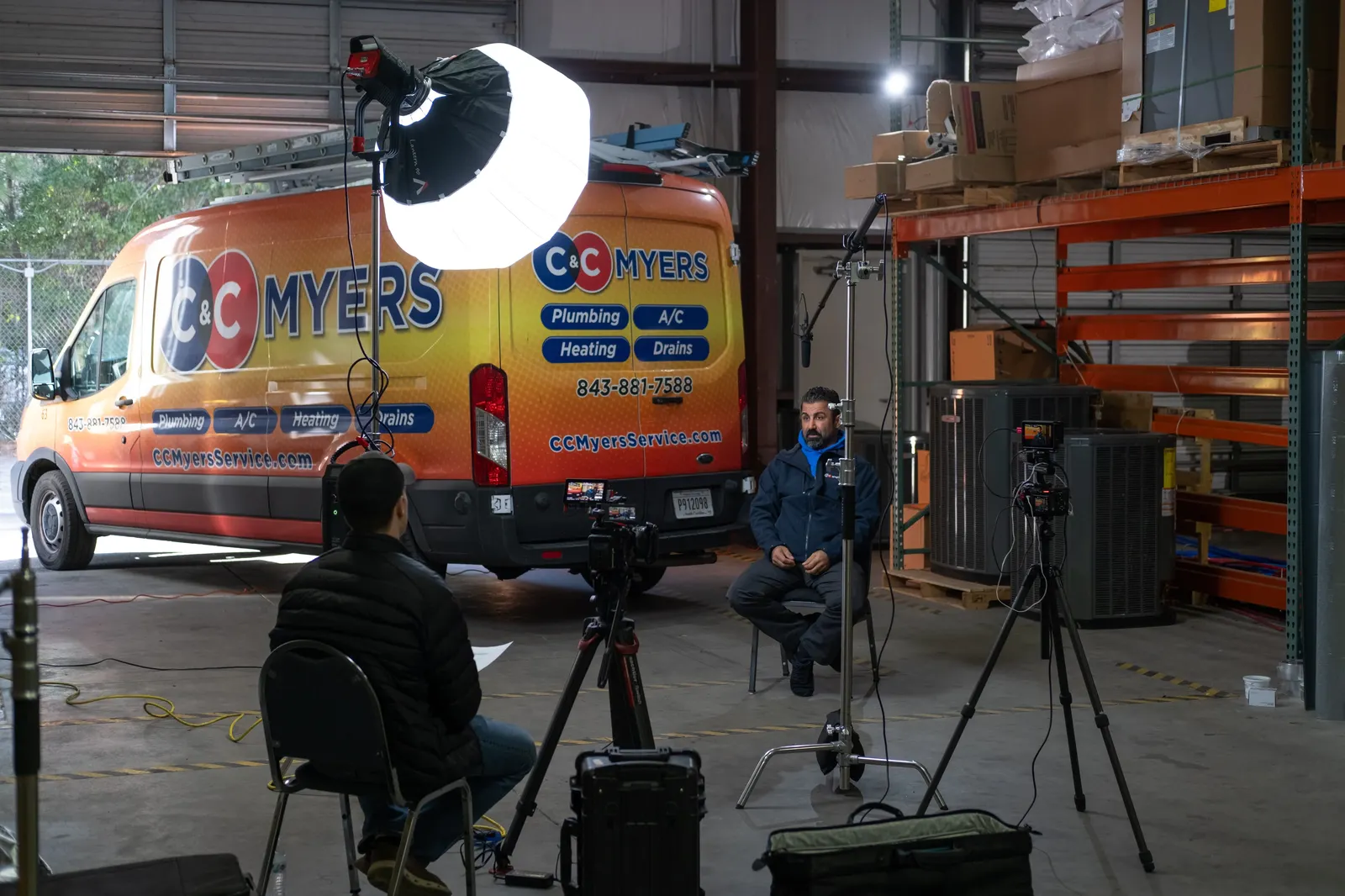
Video lets buyers get to know you before they take a call. That’s the heart of our video-first approach at High Tide. Founder introductions, process walkthroughs, client stories and recorded demos a champion can forward all build trust. If you’d like help producing them, see our video marketing services.
Events and trade shows
Trade shows and industry events still work in many B2B niches, if you book meetings in advance and follow up within a day.
Partnerships and referrals
List the companies that serve your ICP before or after you do (an accountant for a law firm, an architect for a builder) and build simple co-marketing with them: joint webinars, guest articles, referral agreements and shared events.
Account-based marketing (ABM)
Account-based marketing flips the funnel. Instead of attracting many leads and filtering them, you pick a short list of high-value target companies and market to the buying committee at each one, through personalized outreach, LinkedIn ads aimed at those accounts, direct mail and tailored landing pages.
It makes sense when deals are large and sales and marketing can work the accounts together. Start with 20 to 50 accounts, not 500.
Which social media platform is best for B2B marketing?
For most B2B companies, LinkedIn is the primary platform, with YouTube close behind for video that also ranks in search. Facebook and Instagram can also work for B2B companies that sell to small business owners and sole proprietors. Pick one or two platforms and do them well instead of posting thin content everywhere. Our social media team can help you decide.
Step 6: Build a website that converts B2B buyers
Your website is where every channel sends people, so it has to do more than look professional. A B2B website should help each member of the buying committee find what they need and take a clear next step.
The pages that matter most:
- A homepage that states who you help and what result you deliver in one sentence
- Service pages with process, deliverables, timelines and FAQs
- Industry pages for each vertical you serve
- Case studies with the problem, what you did and what changed
- An about page that shows the people behind the work
- Pricing guidance, even as a range or a “projects typically start at” figure, so finance doesn’t rule you out
Then design clear conversion paths. Every important page should have one primary call to action (your high-intent offer) and one softer option (a guide or video) for people who aren’t ready.
Keep forms short, add a calendar so ready buyers can book on the spot, and put testimonials and client logos next to every form.
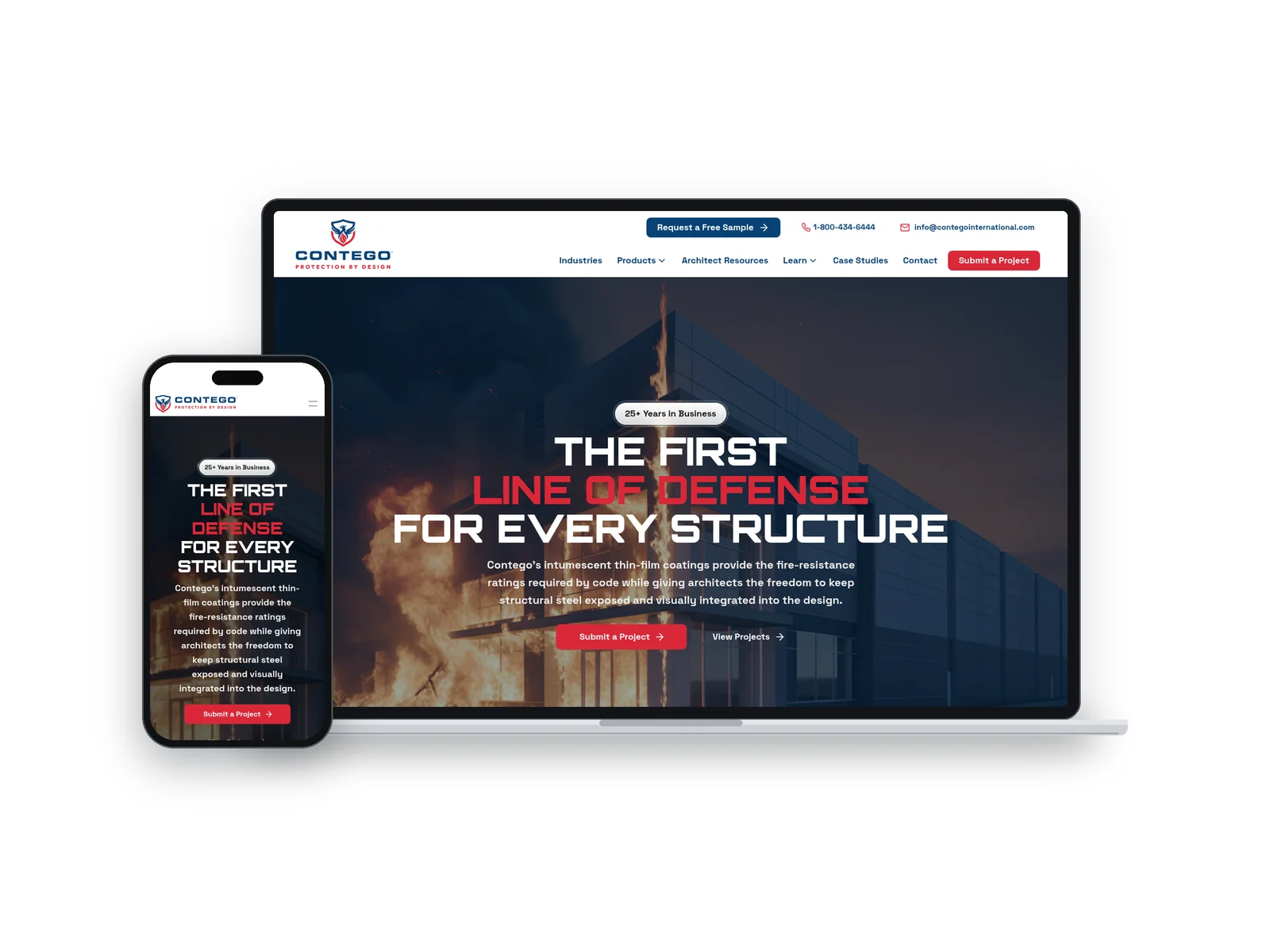
A custom website we built for Contego International.
Every site we build at High Tide is custom, never templated, and it’s SEO and AI SEO ready from day one. If your current site isn’t producing conversations, take a look at our website design services.
Step 7: Capture and qualify leads
Not every lead is ready to buy, and not every lead is a fit. Qualification keeps your sales team focused on the right conversations.
Start with shared definitions:
- Lead. Anyone who gives you contact details.
- Marketing qualified lead (MQL). A lead that fits your ICP and has shown real interest, such as requesting a consultation or viewing pricing pages several times.
- Sales qualified lead (SQL). An MQL that sales has spoken with and confirmed has a need, budget, authority and timeline worth pursuing.
A simple lead scoring model can help. Give points for fit (right industry, right size, right title) and for intent (requesting a call, visiting pricing or case study pages, opening several emails). Leads above your threshold go to sales right away.
Your forms can do some of the qualifying for you. Add one or two dropdowns, such as company size or timeline, so you can route urgent, high-fit leads to the right person instantly.
Many B2B website visitors never fill out a form at all. If you’d like to see which companies are researching you, High Tide also offers Radar, an add-on that identifies website visitors and syncs them to your CRM so sales can follow up with context.
Step 8: Follow up fast, because speed to lead decides deals
This is where most B2B companies lose money they’ve already spent. A lead that waits for days is usually a lead that’s gone cold or talked to a competitor.
The best-known research on this is The Short Life of Online Sales Leads, published in Harvard Business Review. The researchers studied 1.25 million sales leads received by 29 B2C and 13 B2B companies. Firms that tried to contact a lead within an hour were nearly seven times as likely to qualify it (have a meaningful conversation with a decision maker) as firms that waited even one more hour, and more than 60 times as likely as firms that waited 24 hours or longer.
In a separate test of how companies responded to web leads, the same researchers found that only 37% responded within an hour, 24% took more than 24 hours and 23% never responded at all. The average response time was 42 hours.
The study is from 2011, but buyers haven’t become more patient since. Here’s the follow-up cadence we recommend for an inbound B2B lead:
| When | Action |
|---|---|
| Instantly | Automatic email confirming you received the request, with a calendar link and what happens next |
| Within 5 to 60 minutes | Phone call from a real person, followed by a short personal email if there’s no answer |
| Day 1 | Second call attempt at a different time of day; text if they gave you a mobile number and consent |
| Day 3 | Email with one useful resource (a case study or video) related to their request |
| Day 7 | Call and email |
| Day 14 | ”Close the loop” email asking whether to keep the request open |
| After that | Move to a monthly nurture sequence instead of dropping them |
Route leads to a named person in real time, not a shared inbox, and decide who covers after hours and weekends.
Step 9: Use a CRM to track and nurture every lead
A CRM (customer relationship management system) is where every lead, conversation and deal lives. Without one, follow-up depends on memory and sticky notes, and you can’t tell which marketing produces revenue.
At minimum, track each lead’s original source and campaign, lifecycle stage (lead, MQL, SQL, opportunity, customer), deal value and stage, every call, email and meeting, and closed-lost reasons so you learn why deals fall through.
Then build nurture sequences that match the buyer journey. Someone who downloaded a buyer’s guide gets a different set of emails than a past client or a closed-lost deal. Keep them short, useful and from a real person.
Step 10: Get sales and marketing on the same page
In a small company, alignment might just mean the owner and one marketer talking every week. A few practices that work at any size:
- Agree on definitions. Write down what counts as an MQL and SQL.
- Set a service-level agreement. Marketing commits to a number of qualified leads, and sales commits to a response time and follow-up cadence.
- Meet weekly. Review new leads, pipeline and what sales is hearing from buyers.
- Close the loop. Sales marks every lead as good, bad or not ready, so marketing can adjust targeting and offers.
Step 11: Measure pipeline, CAC, LTV and attribution
Clicks and impressions don’t pay the bills. Track the numbers that connect marketing to revenue.
| Metric | What it tells you | How to calculate it |
|---|---|---|
| Pipeline created | Value of new qualified opportunities | Sum of open deal values created in the period |
| Cost per qualified lead | Efficiency of each channel | Channel spend divided by qualified leads |
| Lead-to-customer rate | How well leads turn into clients | New customers divided by qualified leads |
| Customer acquisition cost (CAC) | What it costs to win one customer | Total sales and marketing cost divided by new customers |
| Customer lifetime value (LTV) | What a customer is worth over time | Average annual gross profit per customer times average years retained |
| LTV to CAC ratio | Whether growth is profitable | LTV divided by CAC |
| CAC payback period | How long it takes to earn back acquisition cost | CAC divided by monthly gross profit per customer |
As a rule of thumb at High Tide, we like to see a customer’s lifetime gross profit at least three times what it cost to win them. Below that, growth gets expensive. Well above it, you’re probably underinvesting.
Attribution in a long B2B sales cycle
Attribution in B2B is messy, because a deal might involve a LinkedIn post, a Google search, a webinar and a referral over six months. Don’t let perfect be the enemy of useful. Use three layers together:
- Software attribution. UTM tags on every campaign, conversion tracking in Google Ads and LinkedIn, and source fields in your CRM.
- Self-reported attribution. Add a required “How did you hear about us?” field to your main form. It often catches word of mouth, podcasts and LinkedIn posts that software misses.
- Pipeline review. Look at closed deals each quarter and trace what each buyer touched.
A 90-day B2B marketing plan
If you’re starting from scratch or resetting, here’s how we’d sequence the first quarter.
Days 1 to 30: Foundations
- Interview five recent customers and write down your ICP and buying committee
- Write your positioning statement and define your high-intent offer
- Audit your website for clear calls to action, speed and tracking
- Set up or clean up your CRM with lifecycle stages and lead sources
- Install conversion tracking for forms, calls and booked meetings
- Set your budget band and a target cost per qualified lead
- Write the speed-to-lead process and assign owners
Days 31 to 60: Launch
- Fix or rebuild the most important service and industry pages
- Launch a focused Google Ads campaign on your highest-intent keywords
- Start founder-led LinkedIn posting two or three times a week
- Record three to five short videos: introduction, process, top client questions
- Publish your first mid-intent offer (a guide, checklist or diagnostic)
- Build a five-email nurture sequence for that offer
Days 61 to 90: Expand and measure
- Publish two to four SEO articles answering buyer questions
- Launch LinkedIn retargeting or a small ABM pilot for 20 to 50 target accounts
- Hold the first monthly sales and marketing review
- Compare cost per qualified lead and pipeline by channel
- Shift budget toward what’s working and set goals for the next quarter
Ninety days gets you early signal from paid channels. Judge SEO and brand building on a longer timeline.
Frequently asked questions
What is the best B2B marketing strategy for a small business?
Focus beats volume. Define a narrow ICP, build a website with a strong high-intent offer, capture demand with Google Ads and SEO, build trust with founder-led LinkedIn content and video, and follow up on every lead within an hour. Add channels only once those work.
How long does B2B marketing take to work?
Paid search can produce leads within weeks. SEO, LinkedIn content and brand building usually take four to twelve months to show steady results. Because B2B sales cycles are long, expect revenue to lag lead flow by one or more sales cycles.
What percentage of revenue should a B2B company spend on marketing?
Large-company surveys put it near 8% to 9%, and The CMO Survey found 10.1% for B2B services firms in 2026. Smaller B2B companies typically land between 7% and 12%, depending on growth goals.
Is LinkedIn worth it for B2B marketing?
For most B2B companies, yes. Organic posts from a founder or expert are low cost and build trust over time. LinkedIn Ads cost more per click but let you target exact roles and company sizes, which makes them worth testing when your deal sizes are large.
What’s the difference between B2B and B2C marketing?
B2B marketing sells to committees with longer sales cycles and higher stakes, so it leans on education, trust and relationships. B2C sells to individuals who decide faster. Our B2B vs B2C marketing guide breaks down every difference.
Should a B2B company hire an agency or build an in-house team?
Many small and mid-sized B2B companies start with an agency or a fractional marketing lead, because one in-house hire rarely covers strategy, SEO, ads, video and web. Our guide to choosing a marketing agency covers what to look for.
Build your B2B marketing plan with High Tide
If you’d like a second set of eyes on your strategy, our marketing consulting work starts with your buyers, your numbers and your sales process, then builds a plan your team can run. You’ll work directly with me and our tight-knit team, with more than 20 years of combined experience, and we make the process easy on your end.
Book a discovery call. In 30 minutes, we’ll look at your current marketing, your website and your competitors, and you’ll leave with clear next steps.